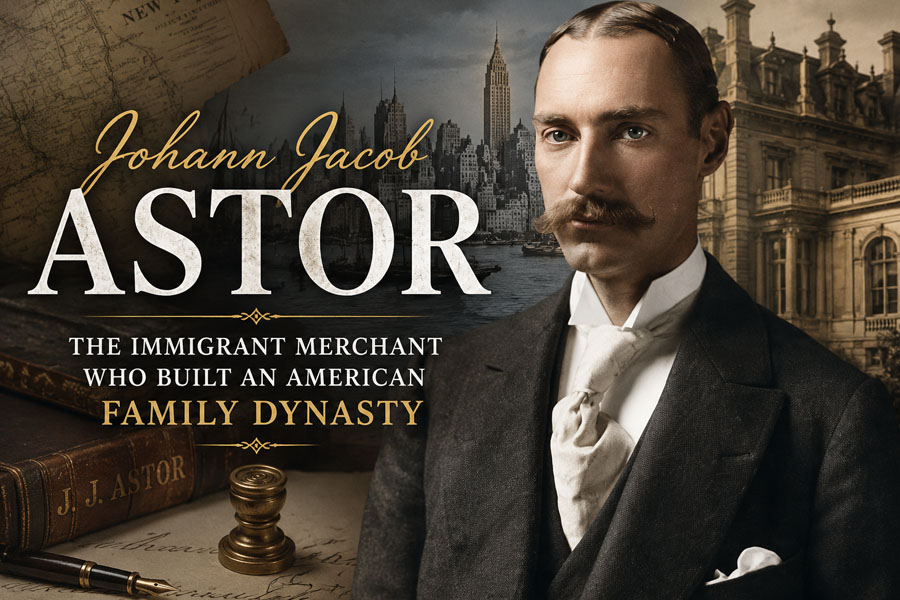
Johann Jacob Astor, more commonly known as John Jacob Astor, was one of the most remarkable self-made fortunes of early American history. Born on July 17, 1763, in Walldorf in the Electoral Palatinate, he arrived in the United States as a young immigrant with little money and a small supply of musical instruments. By the time he died in New York City on March 29, 1848, he had built a fortune estimated at $20 million to $30 million.
Astor’s story is not simply one of money. It is a story of migration, family partnership, calculated risk, international commerce, land speculation, and inheritance. Behind the famous name was a complicated family whose members helped shape the Astor legacy in very different ways.
Basic Information About Johann Jacob Astor
| Detail | Information |
|---|---|
| Full name | Johann Jacob Astor |
| Common name | John Jacob Astor |
| Born | July 17, 1763 |
| Birthplace | Walldorf, Electoral Palatinate, present-day Germany |
| Parents | Johann Jacob Astor and Maria Magdalena Vorfelder or vom Berg |
| Occupations | Merchant, fur trader, investor, real estate owner |
| Wife | Sarah Cox Todd |
| Marriage | September 19, 1785 |
| Major company | American Fur Company |
| Major interests | Fur, international trade, real estate, shipping, government securities |
| Died | March 29, 1848 |
| Deathplace | New York City |
| Age at death | 84 |
| Principal heir | William Backhouse Astor Sr. |
From a German Butcher Shop to the Streets of New York
Astor was born into a modest family. His father, Johann Jacob Astor, was a butcher, and the young Astor spent part of his childhood working around the family business. His mother, Maria Magdalena, died when he was still young, leaving the household shaped by both work and family responsibility.
The Astor family had Waldensian Protestant ancestry. Earlier generations had connections to communities originating in the Alpine regions of Italy and Switzerland before settling in German lands. This background formed part of the family’s longer story of migration and adaptation.
At about 16 years old, Astor left Germany and traveled to London. His older brother George was involved in the musical instrument trade there, and Astor joined him. He learned English while working with musical instruments, including flutes and pianos. This experience was important because it introduced him to international commerce before he ever established himself in America.
In late 1783 or early 1784, Astor crossed the Atlantic. He reportedly arrived in Baltimore with approximately $25 and several flutes. He was an immigrant with almost no capital, but he possessed something that would prove more valuable: an instinct for trade.
He eventually reached New York, where his brother Henry was already established as a butcher. Astor initially worked alongside him, but the fur trade soon captured his attention.
The Fur Trader Who Saw a Larger Opportunity
The fur business was partially accidental for Astor. He learned about the trade from a fur dealer in America. Astor bought and sold animal skins and built contacts with suppliers, traders, shippers, and buyers.
Fur trade fit his personality. It rewarded patience, organization, negotiation, and global market understanding.
Astor expanded his operations throughout the 1790s, taking advantage of changing political and commercial conditions in the US, UK, and Canada. The American Fur Company, formed in 1808, expanded across North America.
He wanted the Pacific Northwest. The 1810–1812 Astor Expedition supported Fort Astoria on the Columbia River. The undertaking was difficult, but it showed Astor’s continental thinking.
His business network went beyond fur. Shipping, international trade, and the lucrative but morally questionable Chinese opium trade were his interests. Shipping, shipping, credit, land, and financial investments became part of a broader commercial machine.
Sarah Cox Todd: The Woman Behind the Merchant
When I look at Astor’s rise, it is tempting to imagine a solitary businessman making every decision himself. His marriage tells a more complicated story.
Astor married Sarah Cox Todd on September 19, 1785. She was the daughter of Scottish immigrants Adam Todd and Sarah Cox. Her dowry was modest, reportedly around $300, but her contribution to the household was far greater than the size of that sum suggests.
Sarah was known for her frugality and practical judgment. During periods when Astor traveled or was occupied with distant business interests, she helped manage affairs at home. She understood money, property, and household finances and became a trusted partner in the family’s development.
Their relationship demonstrates an important feature of the Astor story: the fortune was a family enterprise as much as an individual achievement.
Sarah died in the early 1830s, and Astor was reportedly deeply affected by her death. Their marriage had lasted nearly five decades.
The Astor Children and the High Cost of Life in the Early Republic
Johann Jacob and Sarah had eight children. Not all survived childhood, a reminder of how vulnerable families were to disease, childbirth complications, and infant mortality during the period.
| Child | Dates | Family significance |
|---|---|---|
| Magdalena Astor | 1788 to 1832 | Married Adrian Benjamin Bentzon and later John Bristed |
| Sarah Todd Astor | 1790 to 1790 | Died at birth or in infancy |
| John Jacob Astor Jr. | 1791 to 1869 | Lived a largely private life and did not control the family business |
| William Backhouse Astor Sr. | 1792 to 1875 | Principal heir and builder of the family’s real estate fortune |
| Dorothea Astor | 1795 to 1874 | Married Walter Langdon |
| Henry Astor II | 1797 to 1799 | Died as a young child |
| Eliza Astor | 1801 to 1838 | Married Vincent Rumpff |
| Unnamed son | 1802 to 1802 | Died shortly after birth |
The surviving children followed different paths, but William Backhouse Astor Sr. became the central figure in preserving and expanding his father’s fortune.
William Backhouse Astor Sr.: The Heir Who Expanded the Empire
William Backhouse Astor Sr. was born in 1792 and became the principal heir to Johann Jacob Astor’s estate.
Astor did not simply hand over a pile of money and walk away. William inherited an investment philosophy. Real estate became increasingly important to the family, and William expanded the property holdings that his father had accumulated.
He married Margaret Alida Rebecca Armstrong, the daughter of Senator John Armstrong Jr. The marriage strengthened the family’s connections with America’s political and social elite.
Under William’s leadership, the Astor fortune became deeply embedded in Manhattan real estate. The family owned extensive properties and benefited from the city’s relentless northward expansion.
The strategy was simple in appearance but powerful in practice: acquire land before everyone else realizes its value, then hold it as the city grows around it.
The Astor Siblings and Their Separate Lives
Not every member of the family played a direct role in building the fortune.
John Jacob Astor Jr., born in 1791, suffered from serious physical and mental difficulties and did not become a major business figure. His life was largely sheltered from the commercial world his father dominated.
Magdalena Astor, the eldest surviving daughter, experienced a complicated personal life. She first married Adrian Benjamin Bentzon and later married Reverend John Bristed. Her son Charles Astor Bristed became an author and scholar, extending the family’s influence into intellectual and literary circles.
Dorothea Astor married Walter Langdon and was associated with the Langdon family and its property interests.
Eliza Astor married Vincent Rumpff, who served as a diplomat and consul. Her life was comparatively brief, as she died in 1838.
The family tree therefore spread into business, diplomacy, literature, property, and high society rather than following one single path.
The Astor Brothers Who Came Before the Fortune
Johann Jacob Astor’s brothers were also significant early on.
In London, George Astor worked in the musical instrument business. Johann Jacob initially encountered international trade through the trade.
Henry Astor became a New York butcher. His love in horses led him to import the English stallion Messenger in 1788. Messenger influenced the American Standardbred horse.
Melchior Astor, representing the part of the family that did not cross the Atlantic like his brothers, stayed in Germany.
These brothers shaped Astor’s world. One led him into musical business, another established him in New York, while third maintained the family’s German roots.
Real Estate: The Investment That Outlasted the Fur Trade
Astor eventually recognized that land could provide a more enduring fortune than animal skins.
Beginning around 1799, he acquired Manhattan property on an increasingly large scale. His timing was crucial. New York was expanding, and Astor understood that land that seemed distant or inconvenient could become valuable as streets, buildings, businesses, and neighborhoods moved northward.
Rather than simply selling every property for a quick profit, he often preferred long-term leases. This created a continuing stream of income while allowing the family to retain ownership of valuable land.
By the later years of his life, Astor was widely regarded as one of New York’s great landlords.
The contrast between his businesses is striking. Fur depended on wilderness, hunters, trading posts, rivers, ships, and changing fashion. Manhattan real estate depended on urban growth. Astor shifted from one landscape to another without abandoning his fundamental principle: control valuable assets and wait.
The Grandchildren Who Carried the Name Forward
William Backhouse Astor Sr. had several children, including John Jacob Astor III and William Backhouse Astor Jr.
John Jacob Astor III became a prominent financier and philanthropist. William Backhouse Astor Jr. continued the family’s business and social prominence and married Caroline Webster Schermerhorn, one of the leading figures of New York society.
The next generations transformed the Astor name into a symbol of American wealth.
Among the later descendants was John Jacob Astor IV, born in 1864. He became a businessman, inventor, author, and member of New York’s wealthy elite. His death aboard the Titanic in 1912 gave the Astor name another chapter in public memory.
The family also developed connections in Britain, including the Astor branch associated with the Viscount Astor title.
A Fortune Measured in Millions
At the time of Johann Jacob Astor’s death in 1848, his estate was estimated at approximately $20 million to $30 million. Such figures were extraordinary in nineteenth-century America.
Astor’s fortune was built through several layers of commerce rather than one lucky investment. Fur trading generated substantial profits. International shipping expanded his reach. Financial securities provided another avenue for capital. Real estate eventually became the foundation that anchored everything else.
His greatest financial insight may have been recognizing that a fortune should not depend forever on the business that created it.
The Astor Legacy in New York
Astor’s name became synonymous with New York’s culture and architecture.
The family funded libraries, education, culture, and charity. The Astor Library helped shape the New York Public Library.
The name appeared on hotels, streets, buildings, and communities. The family history helped New York become a global metropolis through the Waldorf Astoria, a world-famous hotel.
From a teenage immigrant transporting flutes across the Atlantic to an American dynasty whose name was engraved into the city.
FAQ
Who was Johann Jacob Astor?
Johann Jacob Astor, commonly known as John Jacob Astor, was a German-born American merchant, fur trader, international businessman, and real estate investor. He was born on July 17, 1763, and became one of the wealthiest Americans of the early nineteenth century.
How did Johann Jacob Astor make his fortune?
Astor initially made money through the fur trade and expanded into international commerce, shipping, and trade with China. His largest long-term fortune came from buying and holding Manhattan real estate as New York City expanded.
Who was Johann Jacob Astor’s wife?
His wife was Sarah Cox Todd. They married on September 19, 1785. Sarah was known for her frugality, intelligence, and practical business judgment and played an important role in managing family affairs.
How many children did Johann Jacob Astor have?
Johann Jacob Astor and Sarah Cox Todd had eight children. Several died in infancy or childhood. Their surviving children included Magdalena, John Jacob Astor Jr., William Backhouse Astor Sr., Dorothea, and Eliza.
Who inherited Johann Jacob Astor’s fortune?
The principal heir was his son William Backhouse Astor Sr. William expanded the family’s real estate holdings and helped establish the Astor fortune as one of America’s most powerful family fortunes.
Who was William Backhouse Astor Sr.?
William Backhouse Astor Sr. was Johann Jacob Astor’s second surviving son and principal heir. Born in 1792, he became a major New York property owner and expanded the real estate empire inherited from his father.
Was John Jacob Astor IV related to Johann Jacob Astor?
Yes. John Jacob Astor IV was a later descendant of Johann Jacob Astor through the family line of William Backhouse Astor Sr. He was a prominent businessman and was among the passengers who died when the Titanic sank in 1912.
What was the Astor family’s connection to New York real estate?
Johann Jacob Astor began acquiring Manhattan property around the end of the eighteenth century. He anticipated the city’s expansion and accumulated large holdings. His descendants continued this strategy, making the family one of the most prominent real estate dynasties in New York.
What was Fort Astoria?
Fort Astoria was a trading post established in 1811 at the mouth of the Columbia River as part of Johann Jacob Astor’s Pacific trading venture. It represented his attempt to extend his commercial network to the Pacific Northwest.
When did Johann Jacob Astor die?
Johann Jacob Astor died on March 29, 1848, in New York City. He was 84 years old and left behind one of the largest personal fortunes in the United States.
Why is Johann Jacob Astor important?
Astor represents an early example of an immigrant building an enormous American fortune through commerce, investment, and real estate. His descendants continued his wealth and influence for generations, turning the Astor surname into one of the most recognizable names associated with nineteenth-century American wealth.