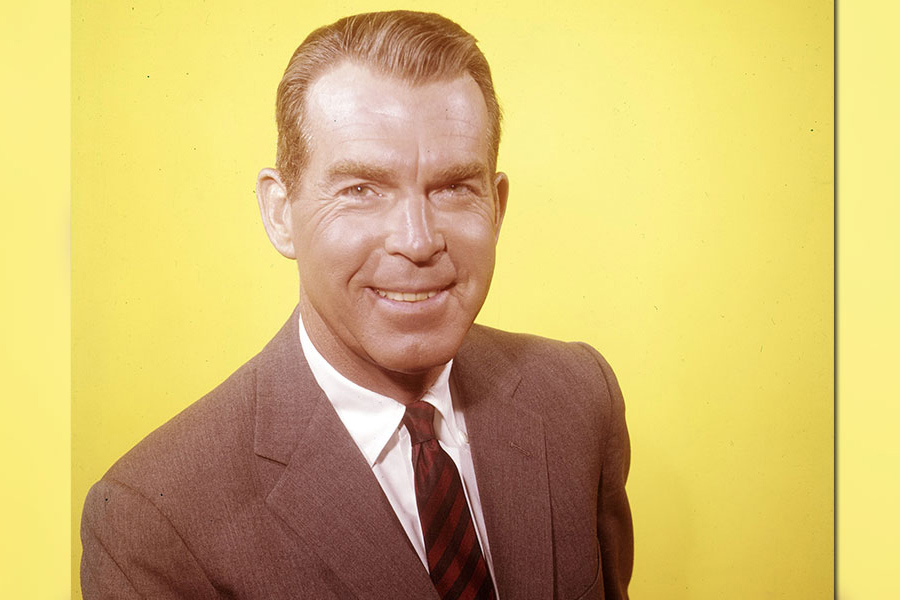
Basic Information
| Field | Details |
|---|---|
| Full name | Frederick Martin MacMurray |
| Known as | Fred Mcmurray |
| Born | August 30, 1908 |
| Birthplace | Kankakee, Illinois, United States |
| Died | November 5, 1991 |
| Death place | Santa Monica, California, United States |
| Parents | Maleta Martin and Frederick MacMurray |
| Spouses | Lillian Lamont, June Haver |
| Children | Susan, Robert, Laurie Ann, Katherine |
| Known for | Film, television, music, business, ranching |
| Best known roles | Double Indemnity, The Caine Mutiny, The Apartment, My Three Sons |
The Early Shape of Fred Mcmurray
One of the unusual Hollywood individuals who seemed to arrive with two lives is Fred Mcmurray. On cinema, he was a reliable presence in movies and TV. The other lived in a peaceful world of family, land, and extended routines and built a working American estate-style home.
He was born in 1908 to a musical and active family. His mother, Maleta Martin, helped anchor the family through a childhood of moving. His father was a concert violinist. Fred was not assigned a career. He was trained by environment, discipline, and performance. It was music initially. Saxophone, band, and stage activity before cinematic fame. That early rhythm counted. He had timing, elegance, and camera-friendly serenity.
I regard his early years as a sort of rehearsal for life. Traveling, adapting, and carrying himself in rooms where talent spoke before fame were his lessons. His cinematic persona would reflect those lessons. He appeared reliable because he had learnt to be.
Family Roots, Marriage, and Children
Fred Mcmurray’s family life was not a footnote. It was a central part of his story.
His parents were Maleta Martin and Frederick MacMurray. His father’s musical background helped shape Fred’s first serious work, while his mother gave the family a steadier domestic center. Fred was an only child, which may have deepened the intensity of those early relationships. There was no large sibling crowd around him. The family circle was compact, and each bond mattered.
His first marriage was to Lillian Lamont, also known as Lily. They married in 1936 and stayed together until her death in 1953. Their marriage lasted through the hardest and brightest years of his early fame. In an industry known for fragile unions, theirs had the texture of something built rather than improvised. Lillian’s health problems played a major role in the family’s choices, especially around having children. That human pressure gave their home life a realism that movie magazines often missed.
With Lillian, Fred adopted two children. Susan joined the family first, followed by Robert. Their arrival created a quieter domestic center, even as Fred’s career kept him moving between sets, studios, and publicity obligations. I find this part of his life especially revealing. He was a star, but he was also a father who made room for children inside a schedule that could have swallowed everything.
Later, Fred married June Haver in 1954. Their connection grew out of Hollywood social circles and deepened into a long second marriage that lasted until his death. June had her own career and her own history, and together they formed a later chapter that was more stable than many people expected from a famous couple. They adopted twin daughters, Laurie Ann and Katherine, in 1956. The family became larger, fuller, and more layered. It was not a polished display. It was a lived-in house, a place where careers, health, children, and time had to make peace with one another.
Career as a Leading Man and Household Name
Fred Mcmurray’s career moved with impressive range. He started in music, shifted into stage work, and then crossed into film in the 1930s. Once Hollywood understood what he could do, it used him widely. He could play a charming leading man, a suspicious husband, a reliable professional, a father figure, or a man quietly trapped by circumstance. That flexibility made him valuable. In some actors, the face is the product. In Fred, the face was the tool.
His breakout screen years came quickly. By the 1940s, he was an established star. He appeared in comedies, dramas, thrillers, war stories, and westerns. His role in Double Indemnity gave him one of the great noir performances of the era. He looked ordinary in the best possible way, which made his darker roles feel sharper. He did not seem carved from marble. He seemed real, and that made tension crackle.
Later, his work in The Caine Mutiny and The Apartment proved that he was not just a star of one decade or one type. He had staying power. Then came television, and with it My Three Sons, which gave him a new generation of viewers. As Steve Douglas, he became the patient center of a family sitcom that ran for years. The role fit him almost perfectly. He had the calm of a man who had already seen enough of life to know that not every problem needed shouting.
His achievements were substantial. He received a Hollywood Walk of Fame star, became the first Disney Legend, and earned honors such as the Artistry in Cinema Award and the Golden Boot Award. What stands out to me is not just the list of awards, but the consistency behind them. He was not a lightning flash. He was steady weather. Reliable, long lasting, and hard to ignore.
Wealth, Work Ethic, and the MacMurray Ranch Life
As a businessman and landowner, Fred Mcmurray was more important than many realize. MacMurray Ranch became part of his personality since he bought it in 1941. Raised animals and managed property. He kept working after the cameras stopped. Simply changing his work.
Years of strong demand made him rich. He was one of Hollywood’s highest-paid actors in the 1940s. Public wealth perception was more striking than private riches. He owned a lot of property, commercial interests, and long-term assets. He feels more like a realistic planner with a great security instinct than a sparkling celebrity.
I suppose his practicality explains his existence. Structure trumped spectacle for him. Even at the height of fame, he was building something to outlive praise. Ranch, family, long marriage, solid work—all part of the same architecture.
Recent Attention, Later Reputation, and Why He Still Matters
Fred Mcmurray died in 1991, but he never fully left public memory. His films still circulate. His television work still finds new viewers. Classic film fans continue to revisit his noir roles, his Disney comedies, and his long run as a dependable screen father. Recent references tend to appear in anniversary posts, film blogs, and social media tributes, where his image is treated with affection and curiosity.
What keeps him interesting is the contrast. He could play danger, but he rarely looked reckless. He could play comfort, but he was never bland. He lived between elegance and practicality, between studio glamour and ranch dust. That combination gives his legacy a certain grain and weight.
FAQ
Who was Fred Mcmurray?
Fred Mcmurray was an American actor, musician, and ranch owner who became a major Hollywood star in film and television. He is especially known for Double Indemnity, The Caine Mutiny, The Apartment, and My Three Sons.
Who were Fred Mcmurray’s parents?
His parents were Maleta Martin and Frederick MacMurray. His father worked as a concert violinist, and music strongly shaped Fred’s early life.
How many children did Fred Mcmurray have?
He had four children through adoption. With his first wife, Lillian Lamont, he adopted Susan and Robert. With his second wife, June Haver, he adopted Laurie Ann and Katherine.
Who were Fred Mcmurray’s spouses?
He was married first to Lillian Lamont and later to June Haver. Both marriages were long and important to his personal story.
What was Fred Mcmurray best known for?
He was best known for his screen versatility, especially in film noir, family comedies, and television. He became a familiar face in American homes through My Three Sons and a classic film presence through Double Indemnity and The Apartment.
Did Fred Mcmurray make money outside acting?
Yes. He owned and worked MacMurray Ranch, invested in property, and approached money with a practical mind. His career wealth was paired with land, business, and long term planning.
Why does Fred Mcmurray still matter today?
He still matters because he represents a rare blend of star power and stability. I see him as a figure who made fame look durable, almost like a well built house that can weather many seasons.